Contents
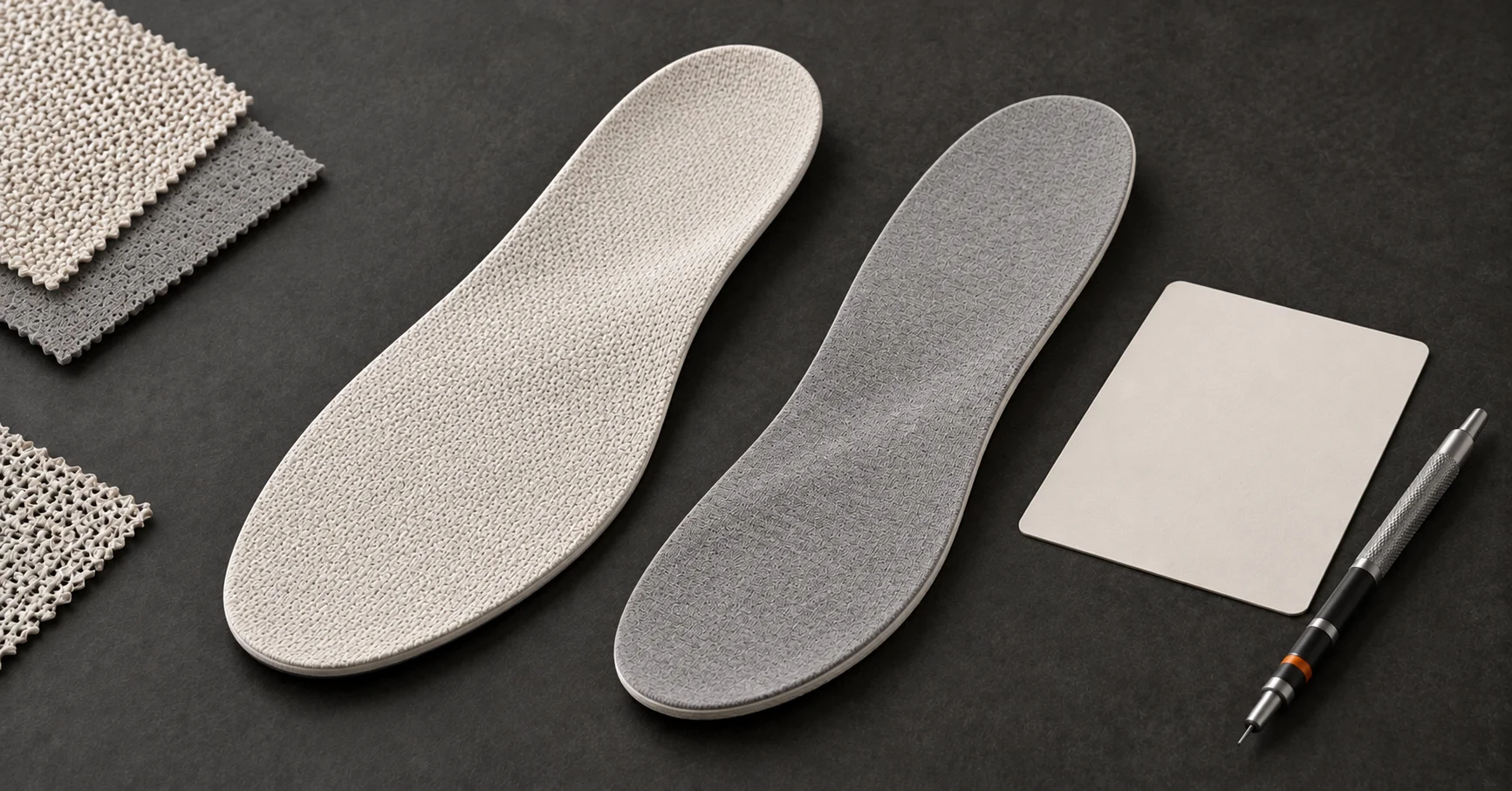
Two insole samples arrive. A feels softer in the hand; B looks slimmer. Which should go into the next shoe sample?
Start by trying each identified proposal in the same shoe setup. Then compare what changes inside the shoe, what the supplier is actually offering, and which claims still need evidence. Hand feel helps you form a question; it does not settle the selection.
Before comparing: identify the insert and the shoe
Here, insole means the insert or foot-contact layer under review. Your supplier may call it an insock, sockliner or footbed. Confirm the actual component on a sample or drawing: these names are not interchangeable in every construction.
Check the arrangement first. A removable insert, a fixed construction component and a medical orthotic require different discussions. This guide compares development proposals; it does not prescribe treatment or structural insole design.
Keep these conditions visible
- Shoe: use an identified sample revision and size.
- Arrangement: record whether the proposal replaces the original insert or sits above it. Ask the developer before removing a fixed component.
- Review conditions: record socks and the conditions of any wear observations.
- Decision: state whether you are selecting a development direction, requesting a revision or reviewing a version for approval.
If B is tried in a larger shoe or a revised upper, record that difference. You can review the combination, but you cannot attribute its result to the insert alone.
Compare what changes inside the shoe
“More comfortable” is difficult to act on. Describe where a reviewer notices a difference and what was happening when they noticed it.
| Review location | What to record | A useful follow-up |
|---|---|---|
| Forefoot | Edge coverage, visible movement and reported change in available space | Is the difference associated with the insert, its position or another changed condition? |
| Midfoot | Where the contour is felt and how it differs between setups | Which part of the proposal should the developer review? |
| Heel and rear opening | Heel position and retention observations | Does the next sample need a change to the insert or the shoe setup? |
These are prompts for a sample review, not acceptable-fit thresholds or diagnostic tests. Identify who tried the sample, the activity and duration, and the location of the observation.
Write: “The reviewer reported more forefoot crowding in setup A.”
Then ask: “What adjustment would you propose, and which other parts of the shoe would it change?”
That gives the developer a specific question without pretending the cause has already been established.
Ask for the complete proposal, not just a material name
Identify the layers and version
Ask the supplier for:
- The article or formulation identifier and reference sample.
- The face layer, base material and any separate reinforcement.
- The contour and intended attachment.
- The document revision describing that proposal.
EVA or PU identifies a broad material family. It does not tell you which formulation, layered construction or contour you are comparing. “Textile face over a foam base” describes an object; “breathable and durable” adds claims that need evidence.
Make thickness measurements comparable
A contoured insert cannot be described fully by one thickness number. Ask where it was measured, how the specimen was prepared and which method was used.
SATRA’s TM159 update [1] discusses specimen preparation, conditioning and thickness measurement in its footbed cushioning method. Keep those conditions with the result rather than comparing two unexplained numbers.
Copy this A/B comparison record
Fill this in while reviewing the proposals. Leave unknowns visible; do not convert them into zero scores or hide them in an overall rating.
| Comparison field | Proposal A | Proposal B | Evidence or next action |
|---|---|---|---|
| Shoe, size and sample revision | Enter reference | Enter reference | Explain any setup difference |
| Original insert arrangement | Replaced, retained or fixed | Replaced, retained or fixed | Confirm intended construction |
| Component identity | Article, formulation and revision | Article, formulation and revision | Match sample to documents |
| Face, base and contour | Describe proposal | Describe proposal | Request missing details |
| Dimensions | Location, method and result | Location, method and result | Check measurement conditions |
| Sample observations | Location, conditions and observation | Location, conditions and observation | Identify the next review question |
| Performance claims | Exact claim and scope | Exact claim and scope | Request relevant evidence |
| Supply and commercial conditions | MOQ, target-volume price basis, material availability and lead time | MOQ, target-volume price basis, material availability and lead time | Flag any substitute or revision that requires a new comparison |
| Test route | Supplier check, independent lab, buyer-nominated method or not available | Supplier check, independent lab, buyer-nominated method or not available | Record report, method/version or the missing evidence |
| Open item | What could change the choice? | What could change the choice? | Assign owner and closure condition |
You may have enough information to request a development sample while still lacking what is needed for production approval. State which decision this record supports.
Choose evidence for the question you need answered
Initial feel can guide sampling. It does not establish long-term cushioning, moisture behaviour or suitability for every wearer.
| Project question | Evidence to discuss | What to check before using it |
|---|---|---|
| How does the proposed surface behave under friction? | SATRA TM184 [2] covers insock and footbed materials, including foam-backed configurations and dry or damp conditions. | Does the specimen represent the proposed face and backing? Are the conditions relevant? |
| What happens to moisture in a wet-use application? | ISO 22649’s public abstract [3] identifies static and dynamic water absorption and desorption methods for insoles and insocks. | Which question does the result answer? Absorption and subsequent moisture release are separate from a vague “breathable” claim. |
| Can two cushioning results be compared? | Discuss the relevant method and sample preparation with the supplier or laboratory. | Are formulation, specimen, conditioning and method edition identified? |
These references identify method scope. They do not set your project's acceptance limits or prove that one material is better. Ask a qualified technical reviewer to assess whether a report supports the proposed version and application.
Turn an unresolved comparison into a sample request
Illustrative scenario: the team prefers A’s initial feel but reports less forefoot space. B gives a different impression, and its construction documents are incomplete. This is a teaching example, not a client project.
There are two open items: an observation about A and an identification gap for B. Neither is a complete reason to approve or reject a proposal.
- 1Describe the observationIdentify the shoe revision, insert version and location. State what the reviewer noticed; keep the proposed cause separate.
- 2Request a defined responseFor A, ask the developer to identify a proposed adjustment and any other construction changes it requires. For B, request the missing construction details before treating the proposals as comparable.
- 3Set the review taskName who will assess the next sample, the setup to use and the observation or evidence needed for the stage decision. Keep the earlier sample and record for comparison.
A useful sample request names the question it must resolve. If several variables change together, review the result as a revised shoe system rather than claiming the material alone caused the difference.
Decide what can move forward
| Decision | Use it when | Record before proceeding |
|---|---|---|
| Proceed | The identified proposal answers the question for this development stage. | Selected version and remaining work |
| Clarify | The direction may be usable, but setup, identity or documents are incomplete. | Exact missing input and its owner |
| Pause | An essential condition is unresolved, and moving ahead would hide it. | Specific reason and what would reopen the decision |
Selecting an insert for the next sample does not approve every performance claim or release the shoe for production.
Carry the chosen version, observations and open items into your footwear Tech Pack and shoe sample feedback. The next reviewer should be able to see what changed, why that version was selected, and what still needs confirmation.