Contents
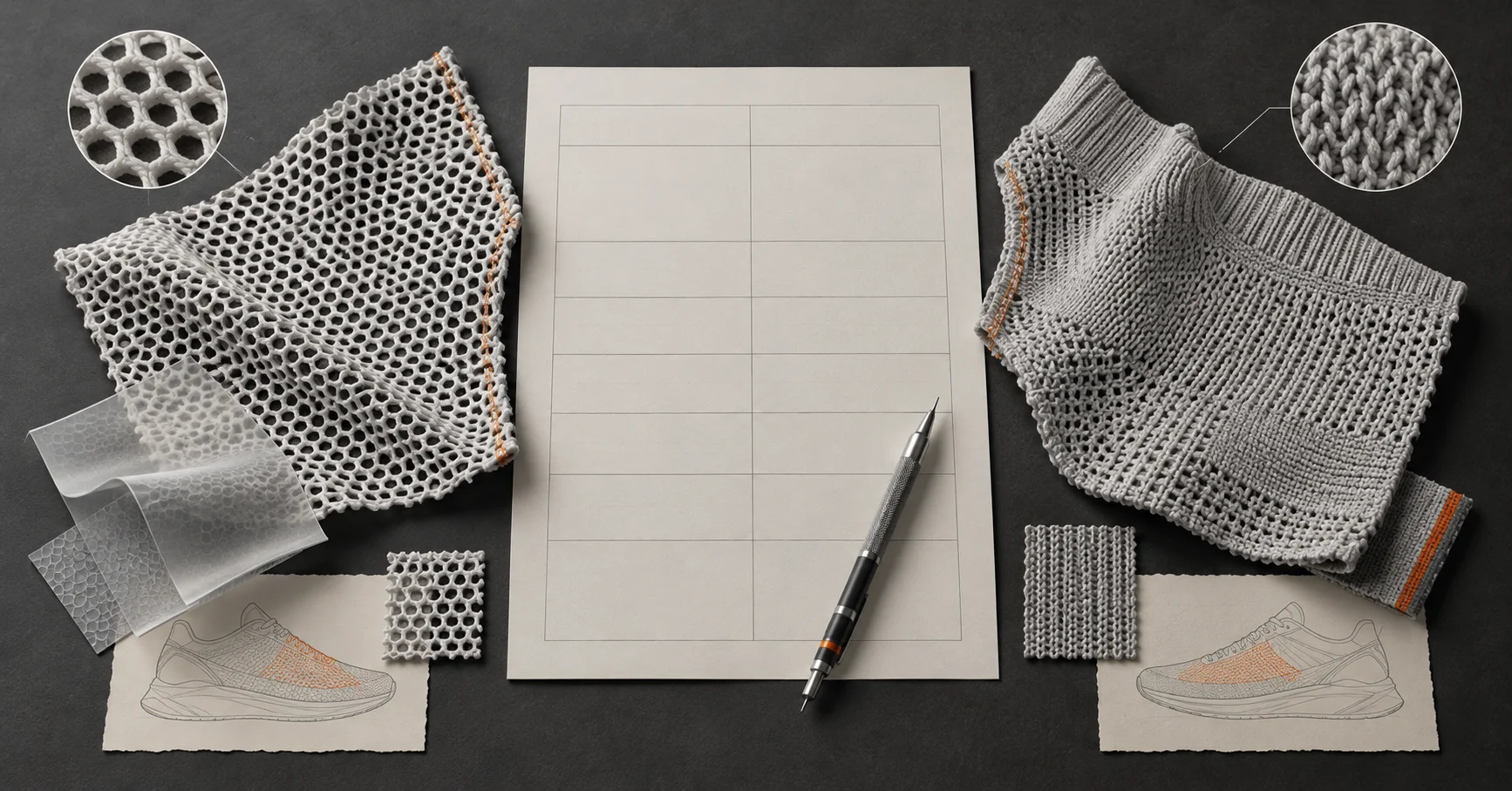
“Mesh or knit?” sounds like a material choice. For a footwear buyer, it is usually a bundle of unfinished decisions.
The words can describe a visible textile direction, but they do not identify the whole upper, the upper zone, the backing or lining behind it, a reinforcement route, the intended use, or the evidence needed before approval. A supplier can respond reasonably to a broad material name and still propose a system that does not answer the product brief.
The practical answer is not to declare one route universally better. Compare two proposed upper systems under the same conditions, then give the next sample a specific decision to resolve.
Do not approve “mesh” or “knit” as if it were a complete upper specification. A material name does not settle the construction, upper zone, adjacent components, sample version, or approval evidence.
Compare the same project conditions first
Do not begin with a generic comparison chart. First make the two options answer the same project question.
Write down the shoe category and intended use, the exact upper zone, the target wearer or fit constraint, the target market where relevant, and the parts that will sit beside the textile. Then state what cannot move: an appearance reference, a construction route, a target feel, an approved pattern, a cleaning expectation, or a commercial constraint.
For example, “knit for a running shoe” is still too broad. Is the decision about the vamp, quarter, collar, tongue, or a one-piece bootie? Does the proposed upper include a lining, an underlay, a film, a printed reinforcement, a separate tongue, or a seam in a high-stress area? The answer can change before the visible textile does.
Use this short Quick Check before you ask for a recommendation:
- Are both options for the same shoe use and upper zone?
- Is the question about appearance, structure, construction, or a performance requirement?
- Which adjacent component or construction decision may change the result?
- What must the next sample allow the team to approve, reject, or clarify?
If any answer is open, keep it visible. A material route can still move into sampling, but it should not be described as approved for bulk.
Treat mesh and knit as parts of an upper system
It is useful to name the visible textile. It is not useful to let that name stand in for the rest of the system.
For each proposal, ask the supplier to identify the material article or code, the stated construction, any backing or laminate, the lining or underlay, overlays or reinforcements, colour or finish reference, and the upper sample that uses that version. Record unknowns as open rather than converting them into assumptions.
This follows the same discipline used in a mesh-upper material record: the visible textile, the layers behind it, and the reinforcements around it must remain connected to a named version and sample.
An upper can also contain more than one route. A proposal may combine a knit area with a less extensible panel, use an engineered mesh with a film reinforcement, or change density and construction across zones. That is why a buyer should compare the proposed system, not a dictionary definition of two material labels.
What to compare before requesting a quote or sample
Use the matrix below for each proposed version. It does not score the options. Its job is to stop important questions from disappearing under a material name.
| Comparison field | What to record for each proposed route | Buyer decision or question |
|---|---|---|
| Project condition | Shoe style, intended use, target wearer, target market if relevant, and upper zone | Are the two options genuinely solving the same job? |
| Visible textile | Supplier article code, stated construction, appearance reference, colour and finish | Is the appearance being compared, or is a performance conclusion being assumed from a name? |
| Layers behind it | Backing, laminate, lining, underlay, foam, or other supplied layers | Which layer affects the decision, and is it included in the quote and sample? |
| Zone and pattern | Location on the upper, pattern-piece boundaries, seams, tongue/bootie route, neighbouring components | Does the proposal change fit, construction, or a local stress point? |
| Reinforcement | Overlay, print, film, tape, extra layer, or other reinforcement; location and construction route | Where is structure being added, and what trade-off does it introduce? |
| Making route | Known cutting, joining, stitching, bonding, lasting, printing, and finishing assumptions | Can the supplier make this route consistently in the proposed construction? |
| Appearance control | Approved swatch, texture/opening reference, colour route, logo or print requirements | What has been approved visually, and what remains open? |
| Verification question | The one condition the team needs to check on the sample or through evidence | What method, specimen, owner, and decision rule will answer it? |
| Version control | Quote revision, material version, sample ID, date, and change history | Can a later substitution be recognized before it reaches bulk? |
The important distinction is between a request and a result. “Need support at the quarter” is a request. “This version provides enough support” is a conclusion that needs an agreed sample review or other appropriate evidence. Keep the two separate.
Ask suppliers for a comparable proposal
A useful supplier request does not ask, “Which is better?” It gives the supplier enough context to propose a versioned route and exposes the questions that the supplier cannot decide for the buyer.
For this shoe and named upper zone, please propose the mesh and knit routes you consider suitable. For each route, identify the material article, stated construction, backing or lining, reinforcements, construction assumptions, reference sample or swatch, and any open limitation. State which sample will use each version and what you recommend we verify before approval.
That request lets a supplier contribute material and construction knowledge without turning a missing product decision into the supplier's guess. It also makes proposals easier to compare: the buyer can see whether the two suppliers have priced the same layer system, reinforcement scope, and sample assumption.
If an option changes during development, treat it as a proposed substitution. A similar appearance does not show that the material article, backing, construction route, existing sample, or prior evidence still applies.
Make the next sample decide something specific
The sample should answer the question that can change the route. It should not merely confirm that the shoe “looks good.”
Before sampling, name one to three decisions that need a result. For example, the team may need to review visual match against an approved reference, whether the proposed upper assembly works with the pattern and adjacent components, whether reinforcement placement needs adjustment, or whether a stated product requirement needs a defined evidence route.
Record the sample ID, material version, upper zone, construction assumptions, review date, observation, decision owner, and next action. If the construction or material version changes, do not automatically carry the earlier finding forward.
ISO/TS 20952:2024 frames footwear upper-component performance requirements around suitability for end use. For a buyer, the useful lesson is procedural: define the end-use question before asking for or interpreting evidence. The standard's title and scope do not make either mesh or knit suitable for a particular shoe, and they do not replace project-specific specification, testing, or market review.
A practical approval gate
Move forward when the upper zone, proposed system, visual reference, sample version, and next verification question are clear for the current stage.
Ask for clarification when a quote or sample cannot be linked to a material article, layer description, reinforcement route, or named sample version.
Pause bulk approval when an option has changed but the affected sample, evidence, commercial reference, or buyer-side decision has not been revisited.
This is not a rejection of a supplier or material route. It is a way to prevent a vague direction from becoming an untraceable bulk assumption.
Use the choice sheet
Copy this into the project brief before the next request for quotation or sample:
| Field | Mesh route | Knit route | Decision / next action |
|---|---|---|---|
| Shoe and upper zone | |||
| Intended use and fixed conditions | |||
| Visible textile and supplier article | |||
| Backing, lining, and adjacent layers | |||
| Reinforcement and construction route | |||
| Appearance reference | |||
| Open question to verify | |||
| Sample / quote version | |||
| Evidence needed and decision owner | |||
| Status |
The sheet is deliberately incomplete until suppliers respond and samples are reviewed. Its value is that a missing answer stays visible and owns a next action.
Frequently asked questions
Is mesh or knit better for a running shoe upper?
Neither is a sufficient answer by itself. Start with the shoe use, exact upper zone, fit and structure question, complete proposed system, and sample decision. A consumer preference or material label cannot settle all of those conditions.
Does an engineered mesh upper remove the need for reinforcement?
Do not assume so. Ask what the proposed system includes at the relevant zone and why. A reinforcement decision belongs in the material and construction record, then in the sample review.
Can I approve the material from a swatch?
A swatch can settle a limited appearance question. It does not automatically confirm the complete upper assembly, construction route, sample version, or evidence for a separate requirement. Record precisely what the swatch approval covers.
What should I ask a supplier to send first?
Ask for a versioned proposal: material article, stated construction, layers, reinforcement route, visual reference, quote assumption, sample reference, and open questions. Then decide what the first sample must prove or clarify.
The decision is the upper route, not the label
The right comparison is not “mesh wins” or “knit wins.” It is whether a proposed upper system, in a named zone of a named shoe, gives the buyer a traceable route to the next decision.
Set the conditions first. Ask for comparable, versioned proposals. Use the next sample to answer a stated question. That is how the material choice stays connected to the shoe you are actually developing.