Contents
“PU upper” may be enough to start a conversation. It is not enough to tell whether a supplier has quoted the material you expect, whether a sample uses that same material, or whether a later replacement has been approved. A colour swatch can settle an appearance question while leaving the backing, finish, construction route and evidence unanswered.
The practical answer is a material record tied to a particular shoe and version. You do not need every field closed before the first inquiry. You do need to show what is confirmed, what is proposed and what the next sample must help you decide.
Start with the upper zone and its job
Before asking for a synthetic leather, identify the product, intended use and exact part of the upper. A vamp, quarter, heel overlay and lining are different locations in the same shoe. Record the zone on a drawing or development brief, plus its neighbouring components and any construction decision already made.
Then separate four kinds of requirement:
| Question | What the buyer should state | What remains to verify |
|---|---|---|
| Appearance | Desired colour, grain, sheen, hand feel and approved visual reference | Whether the supplied swatch and shoe sample match the same reference |
| Material construction | Proposed face, base or backing, additional layers and supplier article | Whether the quote and sample use that exact construction |
| Making the upper | Cutting, stitching, bonding, lasting or other relevant process assumptions | Whether the material works in the proposed assembly |
| Performance or market claim | The specific use condition or requirement that matters to this project | Which evidence and qualified decision owner can support it |
These are prompts for a conversation, not universal specifications. If the product is still being defined, mark a requirement “open” and name who will resolve it. Do not hide an unknown inside the word quality.
A lookalike swatch is not a replacement approval. Similar colour and texture do not show that the proposed article, backing, finish, process assumptions or supporting evidence match the version already sampled.
Describe the proposed material without guessing its performance
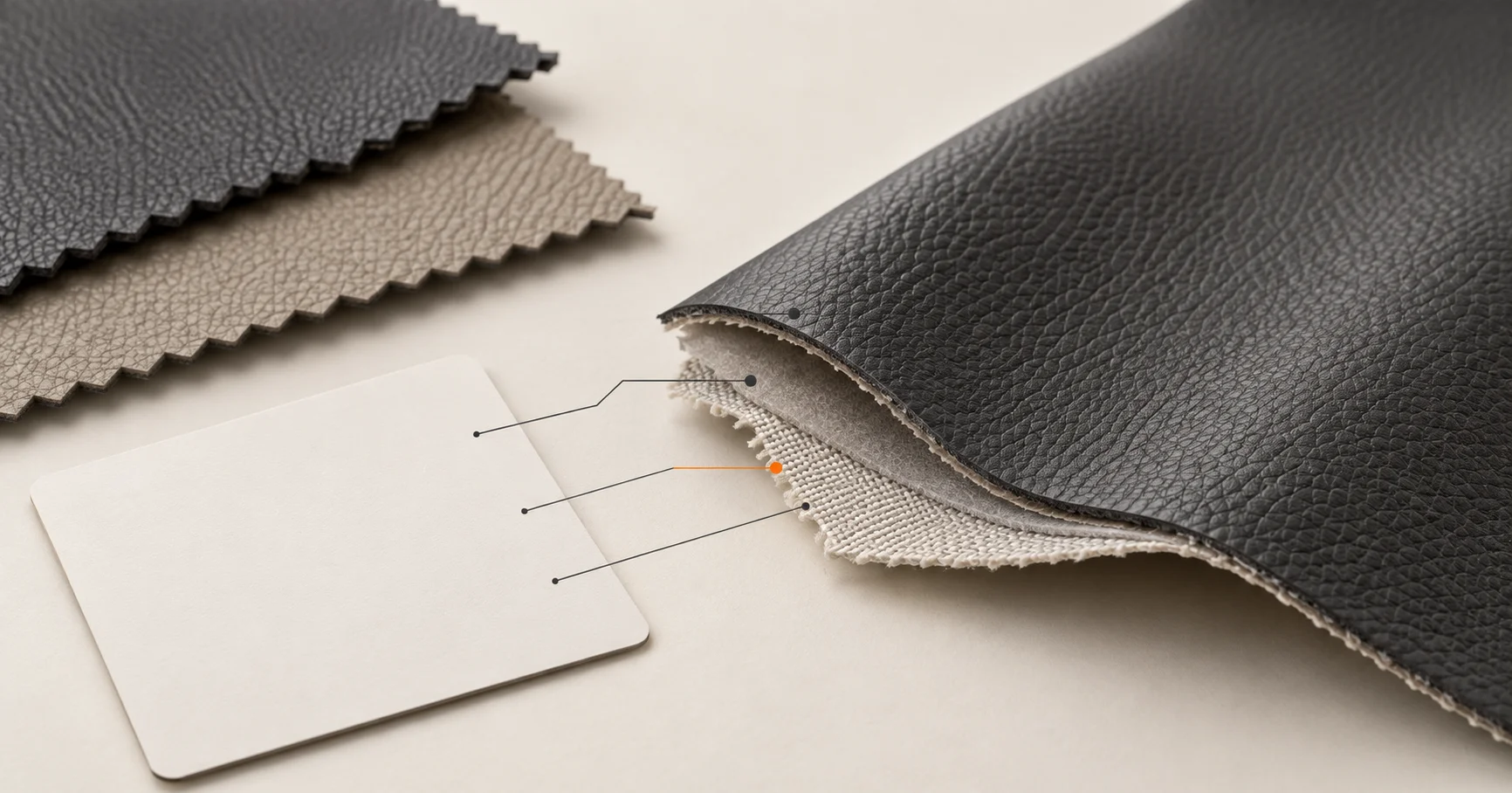
Ask the supplier for its own article or material code. Record the description the supplier provides for the face or coating, base fabric or other backing, any foam or laminate, surface finish, colour route and relevant thickness or weight information. These fields identify what is being proposed; none is a stand-alone promise about durability or comfort.
The exact level of detail depends on the decision. An early design review may only need the article code, application zone, appearance reference and a sample to inspect. Before a quote or bulk approval, the buyer may need a fuller construction record, the applicable technical sheet, an approved physical reference and evidence for the requirements the project actually has. If the supplier cannot yet disclose a layer or source detail, record that limitation rather than filling it with an assumption.
Make clear whether an answer describes a loose material swatch, a cut upper component or a finished upper assembly. Evidence from one may not answer a question about another. The distinction matters when a coating, backing, reinforcement or assembly route changes after the original sample.
Copy this synthetic-leather material and approval record
Use one record per proposed material version. The third column is the useful part: it makes the next question and its owner visible instead of turning the table into a catalogue of adjectives.
| Field | Record for this version | Status / next action |
|---|---|---|
| Product and application | Style or project ID; target user and use; target market; exact upper zone and adjacent components | Confirm the zone on the current drawing |
| Material identity | Buyer material ID; supplier and supplier article code; mill or source if supplied; material revision | Match the quote, swatch and shoe sample to this version |
| Layer description | Supplier-stated face or coating, base or backing, laminate, foam or other relevant layers | Mark unknown layers as open; do not infer them from appearance |
| Appearance | Colour reference, grain or texture, sheen, finish, approved swatch ID and approval date | Say whether approval covers appearance only or more |
| Construction route | Known cutting, stitching, bonding, lasting, printing or embossing assumptions | Ask what changes if the route or adjacent component changes |
| Supplier documents | Technical data sheet, material declaration and care or processing guidance where relevant; document date and version | Check that each document names the proposed article |
| Evidence question | Requirement to verify; method if agreed; specimen or assembly; conditions, result, report date and version | Ask the responsible technical or market-qualified party what evidence fits |
| Shoe sample | Sample ID, size, date, material version used, observations and requested change | Do not carry a finding to a different version by default |
| Commercial reference | RFQ or quote revision and the material assumption it prices | Recheck price and timing if the material changes |
| Decision | Approved for named scope, clarification required, sample requested, substitution proposed or paused; owner and date | State precisely what may proceed and what remains open |
You can copy the table into a footwear tech pack or attach it to an RFQ. The point is to preserve one source of truth as the product moves between development, sourcing and sample review. A quote that says “PU” but does not identify the priced material should stay open until that assumption is clear.
Ask for evidence that answers your decision
Begin with the question, not a long menu of tests. If the concern is how an upper material behaves at a flexing zone, ask the relevant technical parties what specimen, method and acceptance condition would answer it. ISO 17694:2016 describes a flex-resistance test method for uppers and linings irrespective of material. It does not supply a universal result that every synthetic-leather shoe must achieve.
If the question concerns surface colour transfer or bleeding, ISO 17700:2019 describes methods for footwear upper components and related materials under dry or wet rubbing. State which colourway, sample version and use concern prompted the question before interpreting a report. If water-vapour behaviour is relevant, ISO 17699:2003 describes methods for uppers or complete upper assemblies. Do not translate a single material result into a promise about wearer comfort.
The wider frame is end use. ISO/TS 20952:2024 addresses performance requirements for upper components in relation to suitability for their end use; its scope is components rather than the finished shoe. The buyer should define the use and ask the relevant specialist to select and interpret evidence for that product. Keep the method, specimen, conditions and tested material version beside any result.
For restricted substances, product labels, safety categories or environmental claims, identify the destination market and the person responsible for confirming the applicable requirement. A generic supplier claim or an unrelated report is not a substitute for that review.
Decide what can move forward
Proceed to the next development step when the proposed material has an identifiable article, zone, appearance reference and sample plan, and when any unresolved question has an owner. Proceeding to a sample is narrower than approving the material for bulk production.
Ask for clarification when the supplier provides a swatch or quote but the backing, finish, version or supporting document is unclear. A focused reply could be: “Please confirm the article code, layer description and colour reference used for this quote, and tell us which upper sample will use that version.”
Pause an approval or substitution when a new material is presented as interchangeable with an approved one without a new record. First identify exactly what changed: article, source, face, backing, finish, colour route, process assumption or quoted condition. Then decide which swatch, shoe sample, evidence and commercial approval must be revisited. A pause is a request for a decision trail, not a rejection of a supplier's proposal.
Review a proposed replacement against the approved version
Ask for the new article code and a side-by-side change record. Do not let “same PU” or “same look” serve as the comparison. The buyer can use these questions to decide what must be reopened:
| If this changes | Revisit this decision |
|---|---|
| Face, finish, colour route or texture | Does the new swatch still meet the approved appearance reference? |
| Backing, laminate or layer source | Does the existing component or assembly evidence still describe this version? |
| Thickness, hand feel or processing guidance | Does the shoe sample need another cutting, stitching, bonding or lasting review? |
| Supplier article, mill or manufacturing route | Which quote, sample, document and approval need a new revision? |
This is a change-screening tool, not a rule that every change requires every test. Record the proposed difference, the reason for it, who assessed the impact, and the decision that allows or prevents the next step.
Carry the version into sampling and bulk review
The record should travel with the sample. When feedback arrives, record the shoe sample ID and material revision alongside the observation. A comment about colour, feel or surface condition is not automatically a conclusion about a different article or finished assembly.
Before bulk approval, compare the proposed production material with the version the buyer actually reviewed. The pre-production approval checklist covers the wider shoe decision; this record supplies the material identity and open questions for one upper component. If a supplier proposes a change later, retain the earlier approved record and open a new revision rather than silently overwriting it.
The result is deliberately modest: a buyer can say what is being proposed, what has been seen, what still needs evidence and who can authorize the next step. That is far more useful than treating the word “PU” as a complete answer.